






Brand
ReBrand ReView: National Alliance for Care at Home
Did you notice the Alliance's rebrand? Learn more about where it's been and where the brand is headed, along with commentary.
Did you notice Mosai's rebrand? Learn more about where it's been and where the brand is headed, along with commentary.
Megan Murray, VP, Marketing at Mosai, sat down to chat about the company’s rebrand. Stick around for a teardown and peek behind the curtain to see how this rebrand went from concept to go-live.
About the brand: Mosai is a healthcare technology company redefining care in the home. Through a connected platform that combines interoperability, predictive analytics, workflow automation, and secure communication, Mosai empowers home-based care providers and their partners to deliver smarter care transitions, real-time coordination, and better patient outcomes. With Mosai, providers gain transparency across the entire post-acute journey, enabling them to demonstrate performance, negotiate value-based contracts, and operate at peak efficiency. Mosai supports over 1,000 providers nationwide in ensuring patients receive the right care, at the right time, in the right place. Learn more at www.mosai.com.
Forcura and Medalogix merged back in March of 2025, “combining an end-to-end workflow and clinical decision-making solution for post-acute care,” according to their brand guidelines.
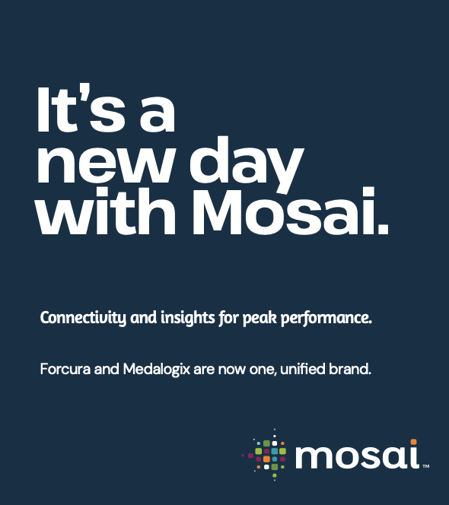
On October 29, 2025, they relaunched as a unified brand under a new name. “Our rebrand was a part of a process with new investors, and the merger of two previous businesses. The key decision in terms of timing was made in an effort to show up to key industry conferences as one brand versus two,” Murray shared.
If you look at most rebrand successes, you’ll notice a common pattern: listening to the customer. Cracker Barrel, Gap, and Tropicana, etc, each of these beloved companies stripped away brand equity and velocity by making drastic changes to the brand that customers weren’t involved in, or bought into. To avoid these types of mistakes, you cannot skimp or skip on customer research and an in-depth brand study.
See how the Mosai team tackled research to make sure that they had buy-in before putting a single name idea on a list.
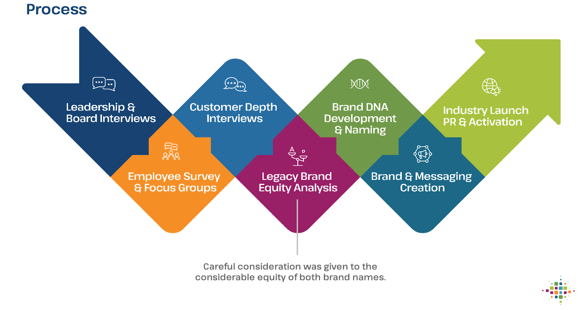
Here is a depiction of the process they used to evaluate the brands and launch the new brand.
“We evaluated both legacy brands and had two options: keep one of the existing brand names or create an entirely new name. Along with some partners, we did a full brand analysis: interviewing customers, industry leaders, partners, leadership team members, and employees, etc,” Murray added. “In total, we had 140 touch points with different people to get input on both legacy brands. We also conducted a brand equity analysis and a competitive/industry analysis. With the number of players in the space today, we wanted to make sure that we looked at everything holistically, to create a new brand that resonated.”
In evaluating both of the brands, it was clear that “our new essence and brand DNA was going to be significantly different from both prior brands. That DNA ended up becoming: Connected Intelligence,” Murray shared. “We found that neither legacy name really spoke to that essence, and we needed to make a switch. Our new DNA really brings things together.”
“From a brand perspective, the personality of both brands was very driven, but how they showed up in the work—and in the customer interviews—was very different. We asked employees (in referring to the brand), ‘What kind of dog are you?’ Both teams said border collie,” Murray added. “Then, we got a secondary dog for each. Forcura was a golden retriever: friendly and dependable. The secondary dog for Medalogix was bloodhounds: for traits like being action-oriented and remaining very evidence(data)-driven. It was very interesting to see the similarities and differences between the two. We wanted to bring it all together and find a rallying cry that everyone could get behind and feel passionate about within the new essence.”
|
Forcura |
Medalogix |
|
Border Collie |
Border Collie |
|
|
|
|
Golden Retriever |
Bloodhound |
|
|
|
One way that the team socialized the new brand creation was 1 + 1 = 3. Something that was also talked about by Personify Health after Virgin Pulse and HealthComp merged.
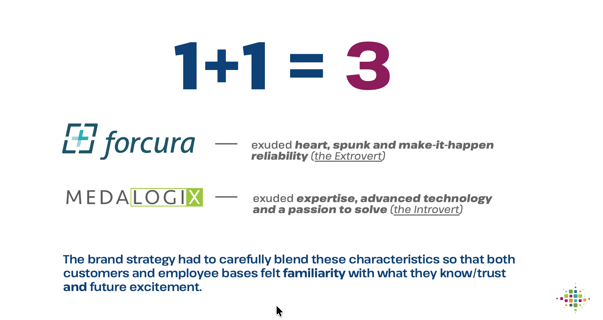
“We chose High Reason to help us with the preparation work because they knew our industry and the nuances of the healthcare industry as a whole (rather than individual segments like home health and hospice),” Murray added. “They helped us develop the process, conduct the interviews, and recap the insights. They also presented their findings to our internal teams. It was important in going from two businesses with 100 employees—to one with 200—to bring the teams along on the journey. We wanted to make sure that they understood the feedback from each, distinctive touch point.”
We can’t talk about the new verbal identity and not start with the company name. “We went through almost 400 names. We came up with a lot of them along with High Reason. In the end, we selected Mosai because it spoke to gathering the scattered pieces of healthcare that both companies bring together, and create a picture of care,” Murray added. “We thought that was quite elegant, and the brand story instantly clicked for anyone who heard it. High Reason helped us to create the brand guidelines, messaging, and positioning for Mosai.”
RELATED READING: A Role-Play Exercise For Naming Your
“We wanted to stand out. From a name perspective, we had Forcura, which was soft, whereas Medalogix was very hard. We needed to find something in the middle, which Mosai covered. You have the hard first sound and then a soft sound after it,” Murray shared. “We talked about mouthfeel and how you would introduce yourself at a conference. My favorite random question was the CFO test. We considered, ‘How does this brand show up in something like an invoice?’ We want to be sophisticated enough to handle all of the different use cases that our brand would appear in, and all of the audiences that it would be in front of.”
“Mosai also ends in AI, so we’re hinting at the sophistication of our platform and the world that we are in today (without being so bold). It’s something that we can dial up or down, and the name gives us the flexibility to do that.”
In terms of tone, voice, mission, vision, and values, the Mosai team was starting anew. “The new mission: ‘Advancing intelligent, connected care at home,’ brings forward the brand DNA. Our vision, on the other hand, leaned into where we saw the industry going. For us, this means that every patient gets the right care, at the right time, and in the right place. We trickled that into everything that we did, but the essence was Connected Intelligence.”
“We also partnered with Powerhouse Planning, specifically to help us rebrand some of the assets that we were creating. From a website perspective, we worked with Blend B2B, based out of the UK.”
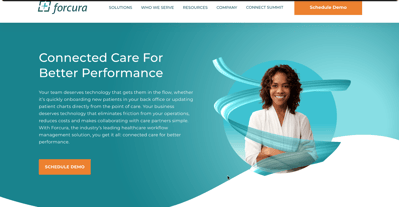
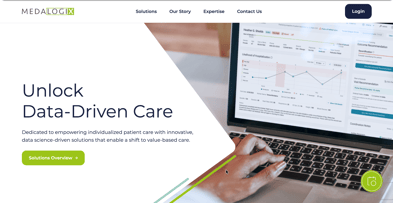
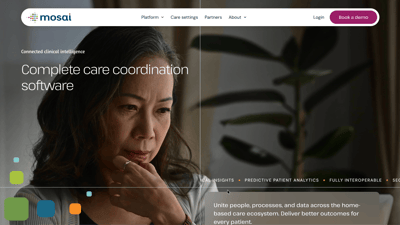
Let’s examine both of the previous websites and compare them to the new Mosai website.
|
Before (Forcura) |
|
|
Before (Medalogix) |
|
|
After (Mosai) |
|
Forcura had a softer vibe, while Medalogix leaned into the data. The new verbal identity enabled the visuals to speak to the softer parts of their brand identity, giving them a flexible verbal platform to lean into their product portfolio and the end-to-end care coordination side.
Further down on the home page, they have a phrase: “Connecting every piece of the home care puzzle,” which ties nicely back to their brand DNA while making it easier for readers to understand what they do. What’s more, under their logo farm, they integrate with the major operation systems across the home-based care continuum, to truly operationalize the connective piece. It’s not just copy. It’s true. That’s what makes their verbal identity so robust.
I think one of my favorite phrases on their website is: “Delivering care at home is both a science and an art.” Anyone who works in home care would understand this tightrope walk.
The work of caregivers and clinicians is a delicate art, balancing the science of a care plan and the artistry of helping people remain independent. The more scientific piece lies in the documentation, claims, and reimbursement part of the patient journey.
“In looking at the wide landscape of competitors, we noticed a lot of reds and pinks. From a brand perspective, we wanted to stand out. We also wanted to keep an essence of what we were before,” Murray added. “Our new logo and color palette have three main colors and 10 secondary colors. It’s pretty robust. The M pulls through from Medalogix into Mosai, the teal from Forcura, and the script elements from Forcura with the tails from the A and I. This was our way of representing both existing customer bases and bringing those palettes to the forefront.”
Let’s look at the before-and-after logos.
|
Before (Forcura) |
After (Mosai) |
|
|
|
|
Before (Medalogix) |
|
|
|
In terms of the logo, “it exemplifies a mosaic, helping you to make the connection in your brain with our brand story about gathering the scattered pieces of healthcare and bringing them together,” Murray added. “We knew that wouldn’t be enough, so we leveraged a lot of video and podcasting during the brand launch. We’re also employing puns. We showed up to conferences with bottles of Rosé. We’re really trying to play on the word as much as possible and harness it, along with practicing the pronunciation during QBRs.”
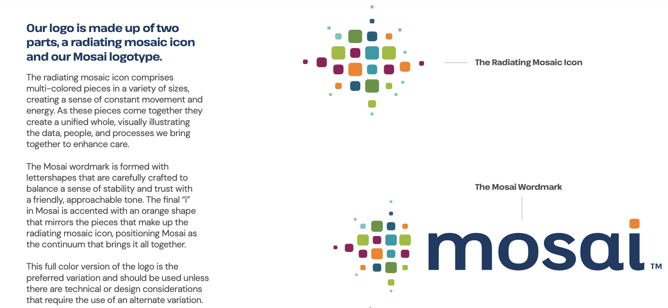
Here is the narrative about their new logo
“This goes back to the brand research, with Forcura being known as the golden retriever: the outgoing, fun, sociable, we wanted to continue that,” Murray shared. “We always had the best, most fun and engaging booth—with the best swag—so this ties it all back to our brand essence,” shared Kate Warnock, Sr. Director of Marketing at Mosai.
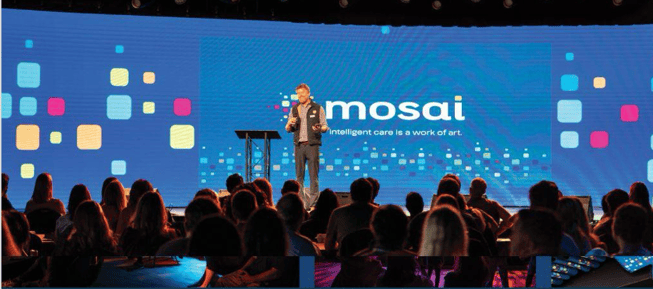
Mosai’s new tradeshow activation
“As we built out the website, we went from three to four products to seven, and we needed to build a user journey that helped to direct people the right way. We created product families, and assigned specific colors to each of the categories based on: admissions solutions, clinical management solutions, and networked care solutions, etc,” Murray added. “We use colors to help define product families. The color is aligned to help tell the story,” shared Warnock.
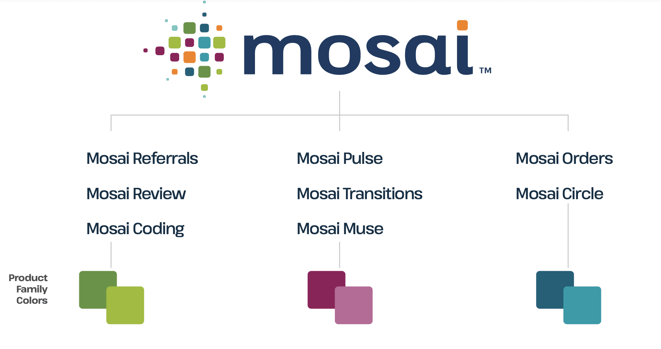
Here is an example of the product family color coding from their brand guidelines
“In clinical management and networked care, we brought the teals in for Forcura. Then, for the referrals and admissions side, we leaned into the Medalogix green. It was fun to take the color palette and apply them as a visual cue for users as theory interfaced with the companies, to make it simpler for them to understand what we do.”

An example of the new brand across channels
“If I put something on a Pinterest board for the rebrand, it would’ve been our existing brands. Forcura had a robust brand. We frequently got feedback, like: ‘you seem bigger than you are.’ We wanted to bring that forward into the new brand. When I look at the Medalogix brand, we were smart, came to play, and our data science is unparalleled.” Murray added. “For us, it was rebranding two incredible brands. The question wasn’t ‘Can we beat what’s in-market today,’ but ‘How can we build something that was greater than what we were coming from?’ Our hope is for the brand to grow, and that Mosai gives it the room to grow into a larger company.”
“In terms of inspiration, it was easy for us to say that we knew what we didn’t want to become, because there are a lot of cookie-cutter solutions in our industry. People use the same stock images, and they all look the same. We wanted to build something new, forward-thinking, and elegant. It’s the combination of being approachable and sophisticated, and we really wanted to pull that through,” Warnock added.
The “anti-inspiration board” is something that Kevin Smith, Chief Executive Officer of Best of Care, brought up during their rebrand process as well. Read the full blog here.
“Let the story do the work. If the brand story doesn’t make sense, it’s going to be incredibly hard to rebrand, no matter who you are. One of my philosophies as a marketer, is that the story helps you to get access. People remember stories, not names or things. And it becomes a work of art. It also happens to be that our tagline, is ‘intelligence is a work of art,’” Murray added.
The power of story was reinforced at this year’s Swaay.Health Live conference. It’s one of our oldest and most powerful forms of communication. Use it to your advantage!
To learn more about Mosai, check out their website: www.mosai.com
Interested in seeing how a marketing partner can help you bring your healthtech company’s rebrand or brand vision to life? Get in touch with Jenn today.
Did you notice the Alliance's rebrand? Learn more about where it's been and where the brand is headed, along with commentary.
Did you notice Alera Health's rebrand from 2023? Learn more about where it's been and where the brand is headed, along with commentary.
Did you notice Eleos Health's latest rebrand? Learn more about where it's been and where the brand is headed, along with commentary.